Beyond Carbon: Should Social Inclusion Be a Measure of Net Zero Success?
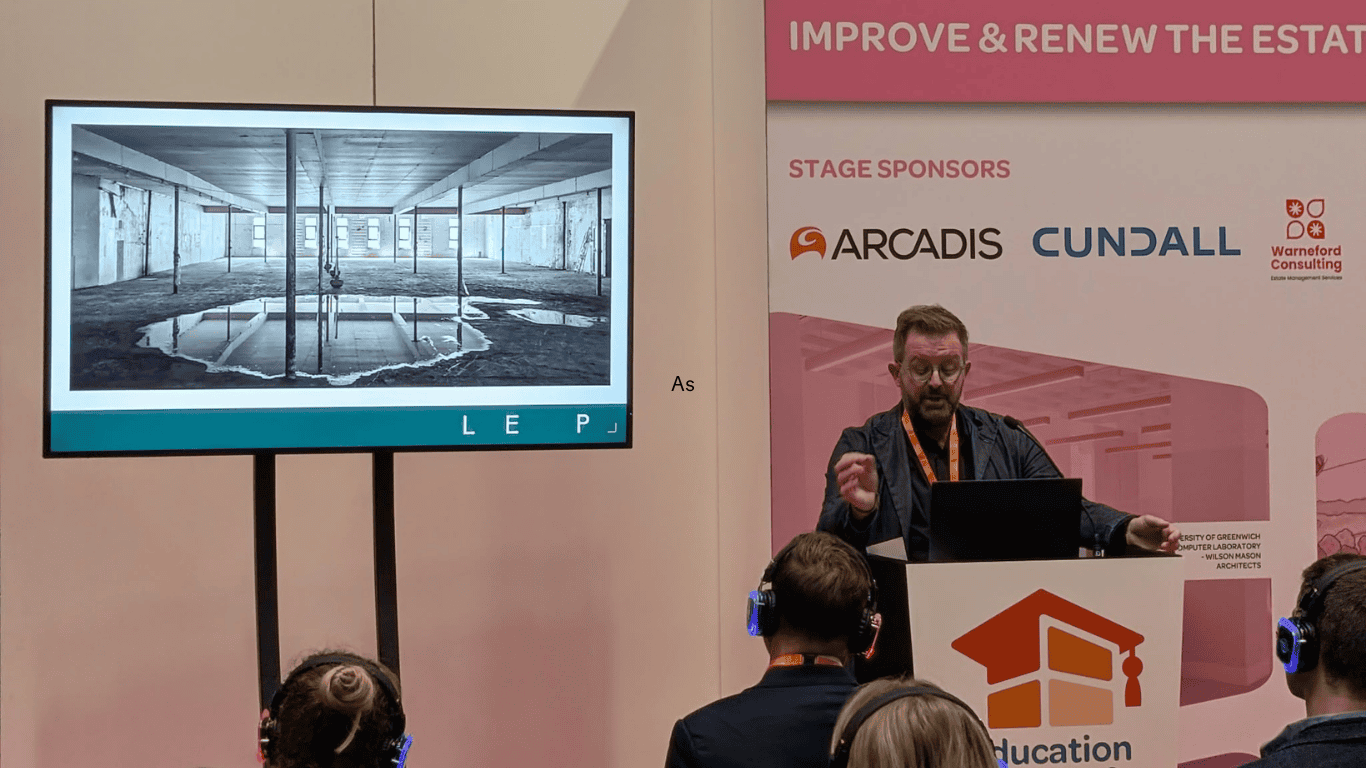
Last week, LEP took part in two very different but closely connected events, starting in Manchester at Education Estates 2026 before heading south to Brighton for the DIIC Annual Conference 2026.
Education Estates 2026, held at Manchester Central brought together those involved in the funding, design, construction and management of learning environments across the UK. LEP Partner Matt Hayes was joined in Manchester by Technical Associate Jonathan Souster, attending Education Estates for the first time, where Matt also presented on Margate Digital, sharing LEP’s thinking and experience around a project that raises wider questions about the changing needs of the education estate.
One thing was particularly noticeable across the two days: the energy around Construction Framework 2025 (CF25) and the aspirations that sit alongside it. CF25 began in January 2026 and provides a framework for the design and construction of educational facilities across England. Alongside that were many discussions around retrofit and reuse. There is a growing recognition that meeting our environmental responsibilities cannot simply be about building new, but about understanding what we already have and finding better ways to adapt and extend its life.
Matt stated “There’s a tangible energy around CF25 and the aspirations for the next generation of education projects. What I found particularly encouraging was how often the discussion came back to retrofit and reuse, and to making more of the buildings and communities we already have. The challenge now is ensuring that our social ambition keeps pace with our environmental ambition.”
For Jonathan, his first Education Estates offered a chance to see the breadth of those issues being debated across the sector: “As my first Education Estates, it was impressive to see so many parts of the sector in one place and to hear the same challenges being approached from different perspectives. What I took away was that good technical design can’t really be separated from the bigger questions around retrofit, sustainability and the experience of the people who ultimately use these places.”
From carbon targets to social outcomes.
From Manchester, Matt travelled to Brighton for the DIIC Annual Conference 2026, where the programme focused on building a more inclusive construction sector. Matt joined a panel on sustainability, using the discussion to raise a question that had become increasingly relevant over the course of the week: if we are serious about net zero, how do we make sure social inclusion is part of the measure of success?
Carbon reduction is fundamental, but sustainability is ultimately about people as well as performance. Our decisions about where and how we invest affect who has access to opportunity, how existing communities benefit from development, and whether the places we create genuinely work for the broadest range of people. That means social inclusion needs to be part of the discussion from the outset, rather than something addressed towards the end of a procurement process.
“If we measure net zero purely through carbon, we risk missing part of what a genuinely sustainable transition should achieve. Social inclusion shouldn’t just be something that earns a few points on an ITT submission. We should be asking how it can become a meaningful measure of success alongside our environmental targets.” says Matt.
For LEP, the journey from Manchester to Brighton reinforced something we see increasingly in our own work: retrofit, reuse, carbon reduction and social inclusion are not separate agendas. In fact, the most interesting work happens when they are considered together.
If we are going to rethink how we invest in and adapt our education estate, then our definition of success needs to be equally ambitious. Not simply how much carbon we save, but what we retain, who benefits and what opportunities our buildings create for the communities they serve.
Thinking about how retrofit, reuse and social inclusion could shape your next project? We’d love to hear from you. Get in touch with the team at office@lee-evans.co.uk.