
A Clearer Direction: Reflecting on the New National Planning Policy Framework
The publication of the new National Planning Policy Framework (NPPF) marks an important moment for the planning system. As updated within the NPPF’s introduction, the Framework is now a material consideration of critical importance to both plan-making and decision-taking, the Framework has a direct influence on how development proposals are assessed across the country.
The new NPPF sends a clear message: the planning system is being asked to become more pro-development, emphasising the delivery of more homes and enabling sustainable growth.
The government’s “build, baby, build” slogan may have been ditched, but the sentiment remains, and it shows in the NPPF updates.
A stronger presumption in favour of development
One of the most significant changes is the way the NPPF approaches the principle of development.
The new Framework introduces policies S4 and S5, dealing respectively with development within and outside settlements. Together, they establish a much clearer starting point for considering whether development should be supported.
For development within settlements (i.e. cities, towns, villages and other predominantly built-up areas), S4 states that proposals should be approved unless their benefits would be substantially outweighed by adverse effects when assessed against the national decision-making policies in the Framework. Also referred to as the ‘default yes’, this position places the starting point for decision making as an approval. Rather than development having to demonstrate why it should be allowed from the outset, the policy establishes a presumption that development should be supported unless there is a sufficiently strong reason not to do so.
This does not however mean that every development proposal will be approved. Planning considerations, environmental impacts, design, infrastructure and other relevant matters remain important. But the starting point has shifted.
S5 continues this theme by setting out circumstances in which development outside settlements can be acceptable.
Importantly, the list of opportunity for development has been expanded. It includes the reuse, extension, alteration or replacement of existing buildings, as well as development on brownfield land and limited infill development within groups of housing.
Perhaps more notably, and heavily publicised within the media, the Framework highlights the potential acceptability of residential and mixed-use development on land considered within reasonable walking distance of a well-connected railway station. This connects the delivery of new homes with sustainable patterns of development.
Plan-making efficiency
The pro-development direction is also evident in the changes to plan-making.
The new NPPF introduces a 30-month plan-making system, with the intention of making the process more efficient and streamlined. This differs from the old system, which set no fixed timescale, resulting in local plan development often taking up to seven years. The Framework places considerable emphasis on the importance of having an up-to-date local plan in place within this timeframe. That matters because an effective planning system needs certainty.
For communities, an up-to-date plan should provide a clearer understanding of where development is expected to take place. For developers, it can provide greater certainty about where growth can be accommodated. And for local planning authorities, it provides the framework within which decisions about growth can be made.
In this way, the updated approach and plan-making system is about making planning faster, clearer and more capable of delivering growth.
Design and Heritage
Design and heritage updates to national policy should not be overlooked and below some of the most important updates are summarised:
- The key principles dictating what should be considered in well-designed proposals have been redefined with the NPPF placing liveability, climate, nature, movement, built form, public space and identity as the key themes for consideration. This reflects a policy update that encourages development proposals to place how space will be experienced by end users at the heart of design, and ensuring that developments consider the long-term impacts of climate change and net zero goals.
- Policies concerning residential densities have also been re-evaluated. A clear shift towards increasing density within settlements has been included within the policy updates both within and, in certain cases, outside of settlements.
- Updates to assessing heritage harm have also been revisited in this update. This iteration of the NPPF provides further clarity on the impact of development on heritage assets and their surroundings. National policy now identifies four scenarios which relate to impact of a heritage setting with a clearly defined list of reasons for what can overcome harm to a heritage asset and substantial harm. This new policy provides greater clarity and support for development proposals proposing to bring a vacant heritage asset back into use.
The housing delivery challenge
Accompanying the publication of the new NPPF, the 2025 Housing Delivery Test (HDT) results have also been released. The HDT results may not have been the spotlight item, but their publication certainly deserve discussion.
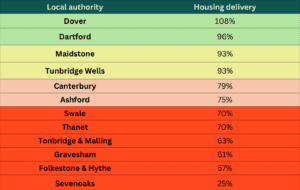
The HDT looks at housing delivery over the previous three financial years and provides an indication of whether local authorities are delivering the homes their areas need. The publication provided detail on all authorities in England, but taking Kent’s local authorities, it shows housing targets are struggling to be met
Of the county’s 12 authorities, only Dover exceeded 100% of its housing delivery requirement. Several authorities are significantly below the level required.
The picture is telling. Sevenoaks, for example, delivered just 25% of its required housing over the measurement period, while Folkestone & Hythe delivered 57%.
The new NPPF makes it clear that an HDT score below 75% represents evidence of unmet housing need and can be used as justification for residential developments outside settlements where proposals are well related to existing settlements and of a scale which can be accommodated by existing infrastructure. On this basis, the majority of Kent’s authorities are demonstrating a significant gap between the homes that are needed and the homes that are actually being delivered.
Summary
The NPPF’s pro-development stance is driven by the need to deliver sustainable growth in all areas with housing being a notable element of that.
The new Framework addresses the need for growth by strengthening the presumption in favour of s
ustainable development, broadening the circumstances in which development can be acceptable, encouraging higher residential densities, and reforming the plan-making process.
There are also changes in other areas, including how development affecting heritage assets is considered. The wider changes to the Framework are in some ways reframing the planning balance so that the delivery of homes and sustainable economic growth carry greater weight.
The Framework reinforces that the planning system should facilitate development. It places greater emphasis on delivering housing, making better use of land, supporting development in sustainable locations and ensuring that local plans are brought forward more quickly.
That does not make planning a free-for-all. Development proposals still need to demonstrate that they can deliver sustainable and well-considered schemes. However, in this iteration, the government have emphasised that the starting point for assessing development has shifted to a positive, pro-development position.